


S&V African Leather Magazine Vol11 No3 March 2017
This Magazine is sponsored by SAFLIA
Click the advert links for more info. • Download PDF







IN THIS ISSUE:
Sector Reports
Feedlots
SA agriculture needs to unite to fight antimicrobial resistance, says Minister.
Slaughter drops more than expected, reports Karan Beef’s Arnold Pretorius.
Hides & skins
Hide prices where they should be, says CPC’s Benjy Lapiner.
Small increase in sheepskin supply, demand steady, says African Hide Trading’s Steven Broughton.
Merino
Exports only way forward, but raw material prices too high, says African Merino Trading’s Simo Simov.
Ostrich
SCOT Doing an about-face on China, says Frik Kriek.
Production must match demand, says Mosstrich MD Francois de Wet.
Ostrich industry needs a different business model, says OPSA’s Saag Jonker.
Footwear
Demand down, supply down further, says Midland Leather’s Rudie Nieuwoudt.
Game
Wildlife Ranching SA ‘commits to transformation’, says Adri Kitshoff-Botha.
Leather Research Institute
DTI ‘has created the environment to support an LRI’, assessment finds.
Opinion – The role of masking agents in pickling
From columnist H. Procter.
Technology
Clean processing technology and sustainable production in the tanning industry Reducing Salt in Tannery Wastewater – Part 10, from Dr Clive Jackson-Moss.
Some hide and leather specifications
Compiled by the ISTT.
Companies
Ecco Leather launches translucent leather.
Pension fund head joins Zambeef board.
Fairs and Congresses
ACLE to coincide with World Leather Congress.
Chinese crackdown on polluting industries ‘will be good for exports’.
Designers return to leather as prices drop.
The ‘Leather Revolution’ – how the industry will respond.
Textiles
China refines its cotton policy – report from ICAC.
Advertisers in this Issue
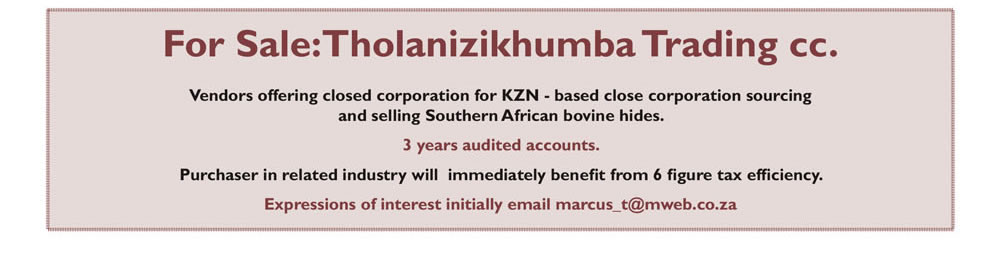
DyStar Boehme Africa (2), Exotic Leather SA (12), ISTT (11), Lanxess (4), Mimosa Extract Co (10), Rolfes Chemicals (OFC), SCOT (6), Tholanizikhumba Trading (7).
- Exports only way forward, but raw material prices remain too high
 Bronkhorstspruit, SA – Last year was our worst year since we first opened in 2003. Our normal turnover would be about R30 million per year. In 2015 that dropped to R10 million, and last year to under R1 million. Essentially the export market is closed to us for several reasons:* Russia doesn’t have the money.* Turkey still imp ...moreDoing an about-face on China
 An interview with South Cape Ostrich Tanning (SCOT) marketing director Frik Kriek. Ostrich has to find new markets – and there are some. Potential markets often have tariff barriers. Customers call for new looks, but buy the tried and trusted finishes ...moreProduction must match demand
 An interview with Mosstrich MD Francois de Wet. Ostrich is a small global player with a unique niche. Pressure to slaughter younger, but there are problems. European demand for fresh Meat is softer than expected ...moreOstrich industry needs a different business model
 An interview with Saag Jonker, founder of Ostrich Products South Africa (OPSA) as part of the Saag Jonker Group of Companies. The ostrich industry needs greater unity. Farmers need a greater share. Let’s be more realistic about grading ...moreSA needs to aim at agreeing to implement strategies that will ensure that AMR is limited and reduced.Presentation by the Minister of Agriculture, Forestry and Fisheries, Senzeni Zokwana, at the Red Meat Industry Workshop on March 16 ...moreSlaughter drops more than expectedJohannesburg, SA – The reduction in cattle slaughter seems to be more than the 8% I predicted in January.For February and March the reduction was 20%.My forecast for April is to be down by 13% and I would think that May will also be down by the same percentage.From June onwards I would think that the situation would return to about ...moreHide prices where they should be.Port Elizabeth, SA – The volatility of the Rand is always a factor. When it was at R12.30 to the Dollar, we were definitely paying too much for hides. At R13,20, hide prices are back where they should be.Hides are less price sensitive than skins for us because there is a big local market with the automotive industry whereas all skin ...moreWRSA commits to transformationThe Wildlife Ranching industry is committed to play a leading role in the transformation of South Africa's agriculture industry. WRSA is committed to work with government to turn million hectares of land into black-owned game reserves that will contribute meaningfully to South Africa's transformation and conservation goals. &nbs ...more
Footwear Industry Articles
- Wayne's Phambili range: Practical boots from non-safety to full protection
 Roodepoort, Gauteng, SA – Wayne's Phambili range combines everyday comfort, dependable durability and clearly defined levels of protection in a practical range of PVC work boots. Developed for demanding working environments, the 3-boot lineup makes it easy to choose the protection best suited to the job while delivering the comfort ...moreTshepo opens new store at Mall of Africa
 Johannesburg, Gauteng, SA (02 June 2026) — South African fashion brand Tshepo has opened its second store at Mall of Africa.Tshepo, founded by Tshepo Mohlala in Victoria Yards 10 years ago, specialises in locally made denim jeans.“Victoria Yards remains central to Tshepo's identity, serving as the bran ...moreNew generation nonwoven components lead the way towards biodegradable shoes
 Compostable and biodegradable footwear is becoming a reality.The nova-Institut für politische und ökologische Innovation GmbH in Hürth, Germany, has published an updated version of its poster, 'Biodegradable Polymers in Various Environments', and project manager Kristijan Mršić told Shoes & Views that several of ...more
Leather Industry Articles
- The leather value chain offers opportunities for all SADC countriesThe Southern African Regional Leather Network (SARLEN) and the SADC Leather Forum present a great opportunity for the development of the leather value chains (LVCs) in all or most SADC states, whose LVCs are at different stages of development.in Zimbabwe we already have a well-structured LVC coordinated by an apex body, the Zimbabwe Leath ...moreBeyond the data trap: Why better decisions matter more than just more data
 On 1st July 2026 I presented at the FILK Leather Days conference and asked the delegates to consider “Sustainability through a new lens: resetting how we view impacts in the leather value chain”. This month’s article therefore explores this idea a little more with a focus on how we view data and whether it can blind us t ...moreOrganic cotton at the crossroads: Ideology, evidence, and the road ahead
 Washington, DC, U.S.A. (23 June 2026) — Organic cotton occupies one of the most contentious spaces in global agriculture. While praised by brands and consumers for its environmental ideals, it also faces persistent questions about yield stability, certification integrity, and scalability. The current edition of The ICAC Recorde ...more
PPE Industry Articles
- More precise fire extinguishing from the air using simulation and sensor data
 Wildfires are becoming more frequent and more intense worldwide. Fires often become infernos due to heat, drought and wind, especially in the summer. The problem is compounded by the climate crisis. Researchers at the Fraunhofer Institute for Industrial Mathematics ITWM and the startup CAURUS Technologies GmbH are responding to this growi ...morePerformance testing: Building credibility in the modern apparel and footwear market
 The lines between protective wear, sportswear, outdoor apparel, wellness clothing and everyday fashion continue to blur. Consumers increasingly expect garments and footwear to deliver more than style alone. Whether purchasing workwear, running apparel, outdoor footwear, school shoes or everyday casual products, buyers now look for comfort ...moreStatistical shape modelling for population-specific respirator design: Addressing fit failure in South African populations
 Respirators are widely regarded as the last line of defence against hazardous airborne exposures. Whether protecting healthcare workers from tuberculosis, laboratory personnel from infectious samples, or workers exposed to carcinogenic dusts and fumes, respirators are often relied upon when other controls cannot eliminate exposure. This r ...more
© S&V Publications


