


S&V African Leather Magazine Vol11 No3 March 2017
This Magazine is sponsored by SAFLIA
Click the advert links for more info. • Download PDF







IN THIS ISSUE:
Sector Reports
Feedlots
SA agriculture needs to unite to fight antimicrobial resistance, says Minister.
Slaughter drops more than expected, reports Karan Beef’s Arnold Pretorius.
Hides & skins
Hide prices where they should be, says CPC’s Benjy Lapiner.
Small increase in sheepskin supply, demand steady, says African Hide Trading’s Steven Broughton.
Merino
Exports only way forward, but raw material prices too high, says African Merino Trading’s Simo Simov.
Ostrich
SCOT Doing an about-face on China, says Frik Kriek.
Production must match demand, says Mosstrich MD Francois de Wet.
Ostrich industry needs a different business model, says OPSA’s Saag Jonker.
Footwear
Demand down, supply down further, says Midland Leather’s Rudie Nieuwoudt.
Game
Wildlife Ranching SA ‘commits to transformation’, says Adri Kitshoff-Botha.
Leather Research Institute
DTI ‘has created the environment to support an LRI’, assessment finds.
Opinion – The role of masking agents in pickling
From columnist H. Procter.
Technology
Clean processing technology and sustainable production in the tanning industry Reducing Salt in Tannery Wastewater – Part 10, from Dr Clive Jackson-Moss.
Some hide and leather specifications
Compiled by the ISTT.
Companies
Ecco Leather launches translucent leather.
Pension fund head joins Zambeef board.
Fairs and Congresses
ACLE to coincide with World Leather Congress.
Chinese crackdown on polluting industries ‘will be good for exports’.
Designers return to leather as prices drop.
The ‘Leather Revolution’ – how the industry will respond.
Textiles
China refines its cotton policy – report from ICAC.
Advertisers in this Issue
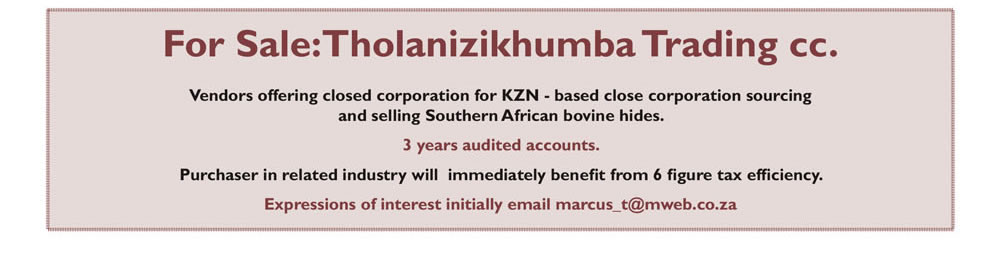
DyStar Boehme Africa (2), Exotic Leather SA (12), ISTT (11), Lanxess (4), Mimosa Extract Co (10), Rolfes Chemicals (OFC), SCOT (6), Tholanizikhumba Trading (7).
- Exports only way forward, but raw material prices remain too high
 Bronkhorstspruit, SA – Last year was our worst year since we first opened in 2003. Our normal turnover would be about R30 million per year. In 2015 that dropped to R10 million, and last year to under R1 million. Essentially the export market is closed to us for several reasons:* Russia doesn’t have the money.* Turkey still imp ...moreDoing an about-face on China
 An interview with South Cape Ostrich Tanning (SCOT) marketing director Frik Kriek. Ostrich has to find new markets – and there are some. Potential markets often have tariff barriers. Customers call for new looks, but buy the tried and trusted finishes ...moreProduction must match demand
 An interview with Mosstrich MD Francois de Wet. Ostrich is a small global player with a unique niche. Pressure to slaughter younger, but there are problems. European demand for fresh Meat is softer than expected ...moreOstrich industry needs a different business model
 An interview with Saag Jonker, founder of Ostrich Products South Africa (OPSA) as part of the Saag Jonker Group of Companies. The ostrich industry needs greater unity. Farmers need a greater share. Let’s be more realistic about grading ...moreSA needs to aim at agreeing to implement strategies that will ensure that AMR is limited and reduced.Presentation by the Minister of Agriculture, Forestry and Fisheries, Senzeni Zokwana, at the Red Meat Industry Workshop on March 16 ...moreSlaughter drops more than expectedJohannesburg, SA – The reduction in cattle slaughter seems to be more than the 8% I predicted in January.For February and March the reduction was 20%.My forecast for April is to be down by 13% and I would think that May will also be down by the same percentage.From June onwards I would think that the situation would return to about ...moreHide prices where they should be.Port Elizabeth, SA – The volatility of the Rand is always a factor. When it was at R12.30 to the Dollar, we were definitely paying too much for hides. At R13,20, hide prices are back where they should be.Hides are less price sensitive than skins for us because there is a big local market with the automotive industry whereas all skin ...moreWRSA commits to transformationThe Wildlife Ranching industry is committed to play a leading role in the transformation of South Africa's agriculture industry. WRSA is committed to work with government to turn million hectares of land into black-owned game reserves that will contribute meaningfully to South Africa's transformation and conservation goals. &nbs ...more
Footwear Industry Articles
- Obituary: Vic Jablowski, BUSM, Protech V (03/09/1953-11/12/2025): One of those who survived BU’s closure
 Durban, KZN, SA – My dad – was AMAZING.Born in 1953, he married Evelyn in 1979. My sister, Luanne Hough, was born in 1980, and I followed in 1983.A family man who made sure he supported his family in the most wonderful ways; he was also a loyal company man who worked most of his life for British United Shoe Machinery.But when ...moreVermont sale completedJohannesburg, Gauteng, SA – After 39 years, former owner Mandy Owen has sold her shares in Vermont Leathercraft Manufacturers (Pty) Ltd to Creek Lab (Pty) Ltd, and officially handed over the business to Prashant Bhaga.In a message on LinkedIn, she wrote: “I would like to thank my husband, Graham, for his invaluable contributio ...moreJulz Shoes launches men’s range
 Sneaker and moccasin style samples from the men’s range.Port Elizabeth, E. Cape, SA – Women’s leather comfort/lifestyle brand Julz Shoes has launched a men’s collection under the brand Will’s Shoes.Both ranges are “locally designed, made offshore”, GM Hayley Barker said.“Julz has built a loy ...more
Leather Industry Articles
- FMD: Government upbeat, little comment from industryPretoria, Gauteng, SA – The Department of Agriculture’s “strategic objective” is to vaccinate 80% of South Africa’s national cattle herd – which is around 14 million animals – against Foot and Mouth Disease (FMD) by December this year, according to a media statement on 12 May.“The vaccinatio ...moreSam Setter's 'Pills': TraceabilityThe EU Commission is very much engaged in bringing traceability of our raw materials to the forefront of tannery management. But let’s reflect on this for a moment. In the industrial world traceability is a fact, and particularly where food is involved, traceability is a standard requirement for trading. This is firstly to ensure fo ...moreSam Setter's 'Pills': Congratulations!Congratulations and compliments to UNIC and COTANCE for the huge job they have done together with LCHA, AHSLEA, Beef & Lamb New Zealand, TDSD, CICB, ALLPI, ICT, ICHSLTA, ICEC and SLF as well as many others by convincing the EU to scrap bovine hides from the EUDR directive. A long and tiring process which has cost them lots of time and ...more
PPE Industry Articles
- The concepts behind safety: Why bother with PPE on the ‘Road to Zero Harm’?
 For over a decade, the ILO and other such bodies have been pushing this whole notion of "Zero Harm", "Road to Zero" and other such catchy titles, all pushing the idea most probably backed by one-sided research that "Zero Harm" is the only way and can be achieved if you work hard enough.My problem with this id ...moreStatistical shape modelling for population-specific respirator design: Addressing fit failure in South African populations
 Respirators are widely regarded as the last line of defence against hazardous airborne exposures. Whether protecting healthcare workers from tuberculosis, laboratory personnel from infectious samples, or workers exposed to carcinogenic dusts and fumes, respirators are often relied upon when other controls cannot eliminate exposure. This r ...moreProtecting the workforce: The critical role of PPE
 Personal protective equipment (PPE) is utilised in a work-environment as part of a larger prevention plan, because on its own protection is limited and may even provide a false sense of protection.An occupational disease prevention plan must be an actionable approach that identifies workplace health hazards, evaluates exposure, and i ...more
© S&V Publications


